From 210 spreadsheets to one live system in two months.
A timber trading company ran its whole operation on monthly Excel workbooks and WhatsApp photos. We replaced it with one system built around how the team already works, starting with the step where the errors began.
A growing business held together by spreadsheets
Every log that came in was tracked across six monthly workbooks with 210 sheets, a 105-species dictionary, a pricing matrix for each customer, and invoices built by hand, one sheet at a time.
The same data was typed in three times: into the daily movement sheet, the lookup file and the invoice. Stock reports were snapshots weeks out of date, and only one person could edit a file at a time.
The first record was written by hand, in the forest
Contractors work where there is no internet. They write log details on a paper slip, photograph it and send it over WhatsApp. Office staff then read the handwriting and re-key every log into Excel.
A “1883” that looks like “1888”, or one species code misread as another, flowed straight into stock, the wrong price and the customer's invoice. A log number entered twice went unnoticed until month-end reconciliation.
One system from contractor slip to customer invoice
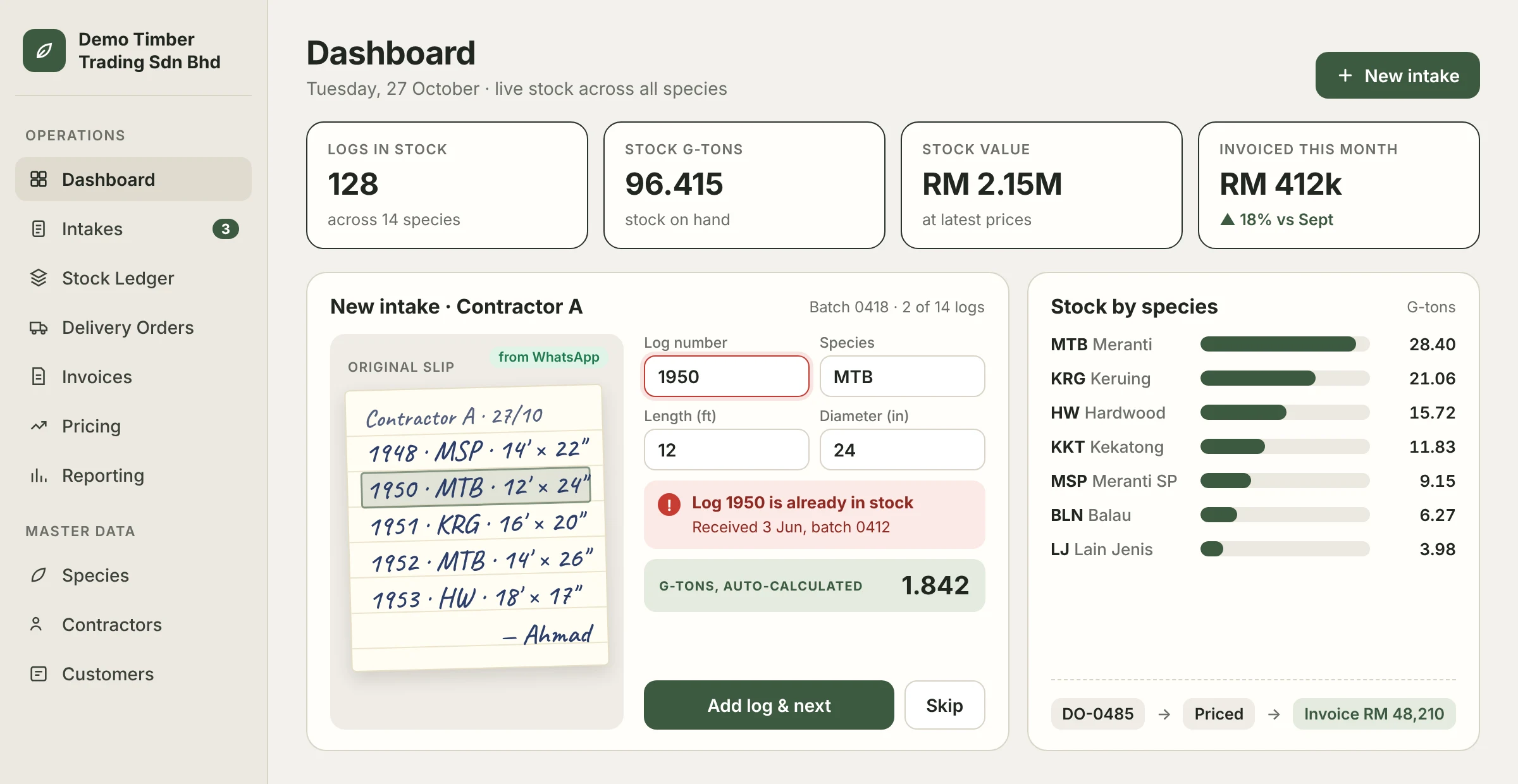
Contractors kept their paper slips, because nothing works without signal in the forest. Everything after the slip moved into one place.
Enter it once, next to the original
Staff upload the slip photo and type each log beside it. No Excel and no second entry.
Duplicates stopped at the door
A log number that already exists is rejected the moment it is typed, not weeks later.
Tonnage worked out for you
G-Tons are calculated from length and diameter on save, so there are no broken formulas.
Live stock by species
Stock updates as logs arrive and leave, replacing the old periodic snapshots.
Pricing and invoices from the same data
Customer price lists by species and size feed straight into delivery orders and invoices.
Traceable end to end
Every log links back to its slip, through stock and delivery order to the invoice, with a record of who changed what.
What changed for the team
| Before | After | |
|---|---|---|
| Data entry | Read the WhatsApp photo, re-key into Excel, then again into lookup and invoice files | Typed once beside the slip photo, then reused everywhere |
| Duplicate logs | Accepted silently, found at month-end | Rejected instantly at entry |
| Source record | Lost in WhatsApp chat history | Attached to every log, one click away |
| Stock view | Periodic snapshot file | Live, by species |
| Invoices | Built by hand, sheet by sheet | Generated from delivery orders and price lists |
| Reporting | Stitched together across monthly workbooks | Any period, in one place |
Two months, kickoff to live
Map the real workflow
We went through every workbook, formula and file to understand how the business actually runs, not how it is described.
Fix the first step first
Contractor intake was where errors began, so the system was designed around it.
Build in short cycles
The team reviewed working screens as they were built, so the system matched their process.
Go live and hand over
Staff moved off the spreadsheets and onto one shared system.
Still running operations on spreadsheets?
Tell us how your team works today. We’ll show you what one system could look like.